Fake prints, bodies, and films won’t destroy the Bigfoot legend, even though they are ubiquitous. Hoaxes just make the cryptid more cryptic, and controversial.
Hoaxing shenanigans are an unfortunately common part of cryptozoology. Those serious about finding Bigfoot must deflect ridicule resulting from the parade of hairy hoaxes that appeared at the beginning of popular interest in the creature and continue up to today. Some incidents are obviously ludicrous and an embarrassment to researchers who aim to be taken seriously. Other finds were roundly criticized or outright debunked, yet they lived on as a questionable piece of evidence that Bigfoot believers held tightly to, hoping that eventually they would be vindicated with a zoologically earthshaking discovery. The footprints started everything.
Jerry Crew and the Wallace prints
Bigfoot first showed up in popular culture in 1958 when the giant hairy creature of the Pacific Northwest gained its infamous moniker after huge prints were found in California. A “level-headed” worker named Gerald “Jerry” Crew, operating machinery on a land clearing/road building job in the forestland of northern California near Bluff Creek, discovered oversized human-like trackways around the equipment. Suspecting a hoax, as the lumbermen are keen to do, he was disturbed by the tracks moving over even difficult terrain for a long distance. A month later, in September, rumor that a giant wildman was visiting the site reached the Humboldt Times newspaper. Editor Andrew Genzoli named the printmaker “Bigfoot” and the American legend of Bigfoot was born. The famous footprint incident set the scene for what was to come over the next 10 years – with speculation and questionable claims giving form and structure to what was previously viewed as a tall tale or myth.
In 2002, the family of Ray Wallace, who owned the company doing the work where the 1958 tracks were found, admitted Wallace, then deceased, had made the trackways himself with fake feet. The reveal made news at the time. The doubters said, “Of course!”. But, by this time, belief in Bigfoot was bolstered by hundreds of eyewitness reports seen as evidence that a real creature existed to match the popular imagination. The Wallace hoax claim was ultimately brushed off by many Bigfooters, as they had already compiled significantly more trackway evidence that, in their minds, nullified this hoax claim. The idea that Wallace was responsible for all the tracks was rejected by some as impractical.
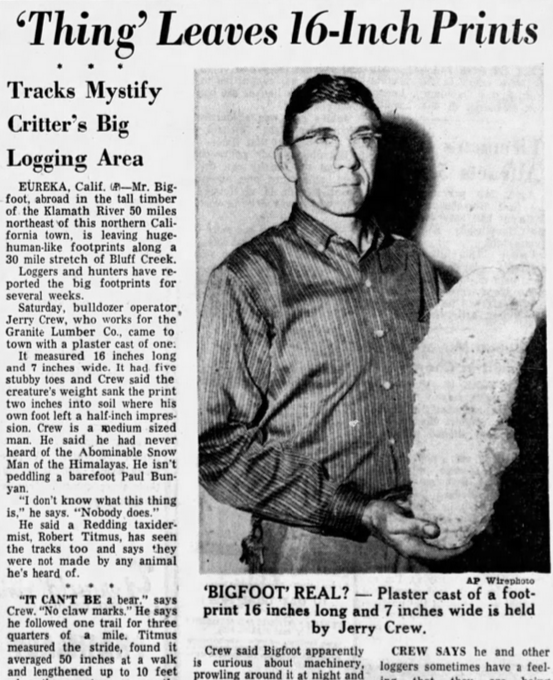
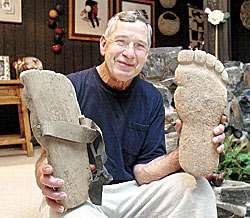
Photo by Dave Rubert
Dale Lee Wallace of Toledo reveals the original feet made from Alderwood his Uncle, Ray L. Wallace, used to make the now-famous bigfoot tracks in 1958.
Those who kept up the hunt for a real Bigfoot treated other potential hoaxes the same way. If they thought an account, film, photo, or physical trace was legitimate, they considered it as evidence for the reality of Bigfoot. If they didn’t see a piece of evidence as legitimate, they ignored it and focused on the other evidence they accepted. This uneven pick-and-choose situation with questionable evidence was at least partially a result of the field of cryptozoology not having an institutional structure. While some of the evidence was discussed in the journal of the International Society of Cryptozoology and related meetings and forums, there was no organized system of publishing and sharing data with regards to Bigfoot/Sasquatch claims. The claimants were amateur naturalists, at best, but there were several out to manufacture evidence just to contribute to the spectacle.
Bodies on display
In 1968, a body of a hairy wildman was exhibited as a real creature by promoter Frank Hansen. Hansen had several unconfirmed origin stories for the creature including that it came from Asia or that he had shot it himself in Minnesota. Known by different names but ultimately as the “Minnesota Iceman”, the body was frozen in a block of ice and taken around the carnival and fair circuit, where people paid to get a glimpse of it. Eventually, founders of cryptozoology Bernard Heuvelmans and Ivan Sanderson were able to examine the frozen specimen. Heuvelmans wrote about it in a Belgian scientific journal, believing it to be the carcass of another species of human he named Homo pongoides. When Smithsonian scientists and the FBI expressed a concerning interest, Hansen pivoted to say he had returned the original to its “owner” and substituted a latex model. Those who expressed the view that the Minnesota Iceman looked (and smelled) real, accepted this excuse and continued to believe it had originally been a real body. The unraveled story made it clear that it had been an gaff the whole time, particularly when the model turned up for sale on eBay in 2013.

The Minnesota Iceman took inspiration from side-shows claiming to have wondrous and weird natural oddities. It inspired others to see if they could fake a Bigfoot body too.
In 2008, Rick Dyer and Matthew Whitton claimed to have encountered several Bigfoots in the Georgia woods and that they fortuitously bagged one. Their story went that they dragged a huge body out of the forest and put it in a freezer. Then they released their story and a photo to the press. Partnering with established Bigfoot huckster Tom Biscardi, the brazen trio held a press conference revealing more photos. The event was covered by some major media outlets. Many Bigfoot believers wanted this to be “the real deal” as Biscardi hyped it, but the hoax was short-lived. When the time came to examine the body, the fakers bolted and the jig was up. It was a retail costume with added animal guts and fake teeth. Dyer said it was meant to be a joke and that “Bigfoot doesn’t exist”. The Georgia Bigfoot Hoax became international news. Because it took only days to reveal the fakery, there was not much time for Bigfooters to consider if it was real. However, at the time, they hedged their bets, but were wary. Surprisingly, Liar Dyer wasn’t finished. He recognized the monetary value of even a blatant hoax.

In 2014, Dyer claimed that he had (really, this time) shot a creature in Texas. This time, “Hank” was a model made of latex, foam and camel hair that he and another partner toured around the US, charging people $10 a head. According to the San Antonio Express News, they pocketed $60,000 before this scam fizzled out. Dyer, as an already an established Bigfoot con artist, was loathed by many Bigfooters. Average people, however, still wanted to see the gaff even though they likely knew it was fake.
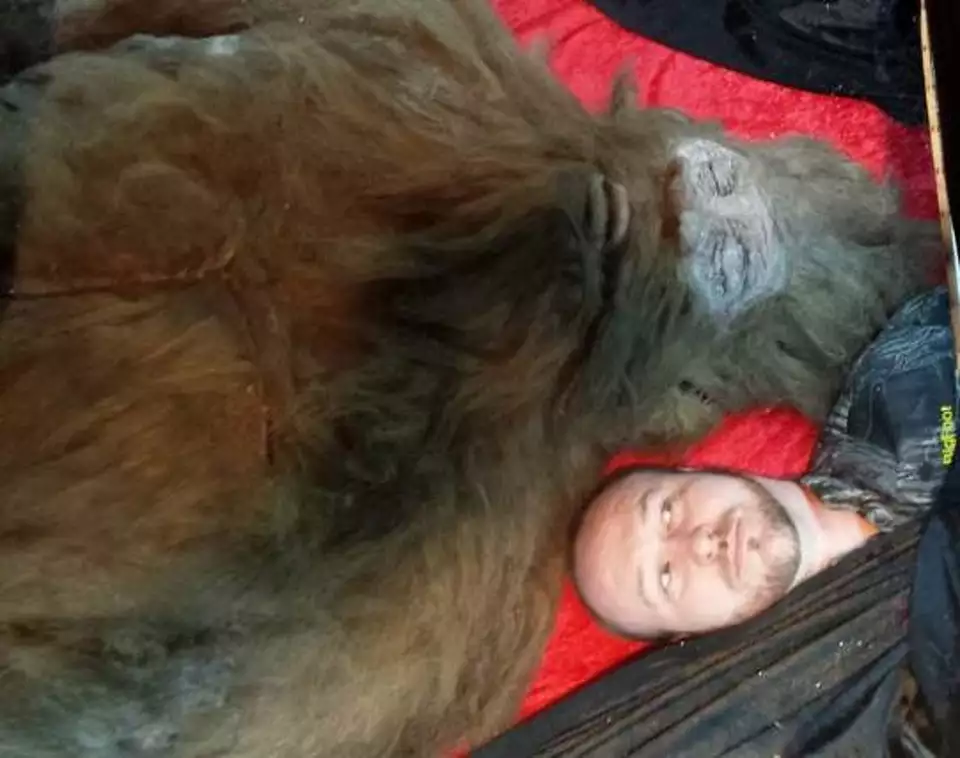
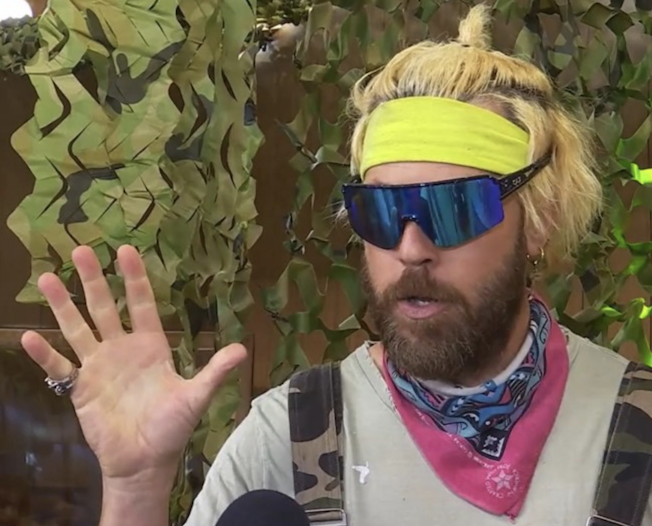
Following from “Hank”, 10 years on, there is “Dack”. Self-titled Bigfoot expert Charles “Snake” Stuart claimed to have found a dead Bigfoot specimen in the Adirondack Mountains of New York in October 2024. A cobbled-together website at BigfootsRemains.com showed the body and a promotional Press Release of detailed nonsense describing the 8ft creature as Neanderthal-human hybrid. “Snake the Bigfoot Hunter” gave media interviews about how he came across the carcass by following a rotting smell after which he and a few buddies dragged the thing out of the woods. Borrowing the tactic from previous infamous gaffs, Snake the Fake put the creature on display at the New York State Fair in 2025. There was nothing about this claim was remotely believable. But it roiled the serious Bigfooters so much that they howled about it. Shortly after the publicity ramped up about Dack, Bigfoot research personality Steve Kulls discovered that the Charles Snake Stuart was really Brian Andrew Whiteley, a visual/performance artist who was known for hoaxing Bigfoot before. Even though Whiteley was putting on a show in making it all up, the news media continued to give him a platform for his performance. He continued over the next year, revealing a (faked) “DNA report” from the “Cornell University Bio DNA lab”. His aim seemed to be to run the schtick as long as possible for attention, even threatening to sue Cornell for its denial of involvement. In this way, his stunt succeeded. Whiteley concocted a caricature of Bigfoot hunters, and took advantage of lack of journalistic integrity, as well as the public appetite for sensationalism and absurdity.

Bigfooters and other cryptid researchers continue to complain that the humbug is bad for the reputation of the field. However, the most successful hoaxes laid the foundation for the popularity of many cryptids, including Bigfoot and Nessie, to the point that the way we think about those creatures today is inextricably tied to the hoaxed portrayal. Most obviously, the ubiquitous image of Bigfoot/Sasquatch is derived from an infamous and highly dubious film.

The Patterson-Gimlin film
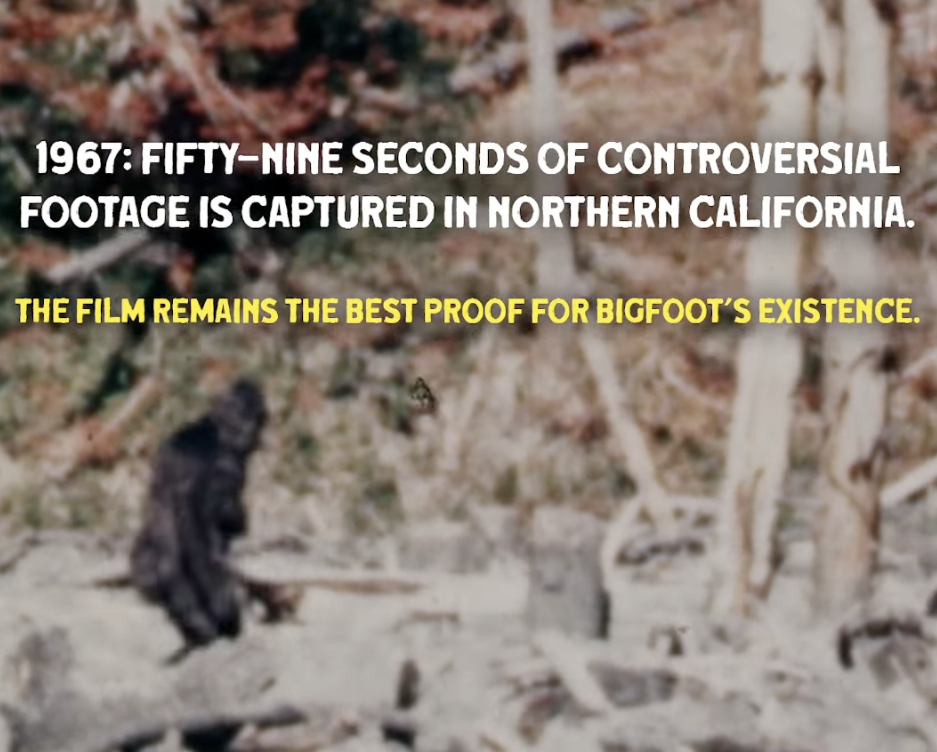
The watershed moment for Bigfoot was the Patterson-Gimlin film of 1967, known to Bigfooters as the “P-G” film. The iconic film shows a hairy, ape-like (female) creature striding across a creek bed, and then furtively looking back before continuing on her way. The short film was well-marketed by the filmmaker, Roger Patterson. Soon after, Roger died without a public confession. Eventually, Bob Gimlin, who was with Patterson when the film was shot, attested to its authenticity in front of eager crowds of Bigfooters at meetups.
The P-G film had been reviewed by eminent scientists of the time. Almost none found it to be compelling as proof of Bigfoot. Patterson’s reputation and shady business dealings did nothing to help his reputation. All indications pointed to a hoax, but the will to believe was strong. In the 5 decades that followed, many tried to recreate the film or prove it was hoaxed. All those efforts failed. The controversial film remained the key piece of Bigfoot evidence, depicting either a genuine Bigfoot or someone in a big suit. People saw what they wanted to see in the figure striding across the landscape.
Everyone who is familiar with popular culture knows the image from frame 352 of the P-G film; it has defined the public’s vision of what Bigfoot looked like from the 1970s onward. The P-G film inspired many to become interested in Bigfoot and cryptozoology in general in the 1970s. About 80% of participants at a Bigfoot conference considered the film a depiction of a genuine Bigfoot (according to Bader et al., 2010).
“The P-G footage compels many researchers to keep looking for “Patty” (the name given to the celluloid-captured Bigfoot) and her kin. The film has been stabilized, analyzed and criticized countless times. With no new input of information, however, the film is a dead-end as proof of Bigfoot. Like trying to enlarge a grainy photograph, you can’t claim details where none were originally recorded.
“It is amazing how two sets of viewers can look at the same piece of film and either see an obvious hoax or certifiable real animal when it can’t be both.”
-Excerpt From Scientifical Americans, by Sharon A. Hill
The various hoaxes, including those by Ivan Marx and Paul Freeman, sowed derision towards Bigfoot/Sasquatch research by the science community. The overly enthusiastic claims from amateurs also damaged credibility (Regal, 2011). A multitude of highly dubious visuals and witness tales continue to be uploaded daily to online platforms because Bigfoot is popular and controversy gets eyeballs.
In Bigfooters and Scientific Inquiry (Lewis & Bartlett, 2025), the authors collected information from dozens of Bigfooters and noted several sociological concepts inherent in pursuing Bigfoot in a way that appears scientific. Those who pursue Bigfoot as a serious subject use the many hoaxes as a way to perform skepticism and to demonstrate they are credible, no-nonsense, and non-gullible researchers. This volume, a logical followup read to my Scientifical Americans, shows that Bigfooters who contend that a real creature is hiding from us use “scientifical” practices such as jargon, equipment, data collecting, reporting and displays of skepticism to appear equivalent to scientists. Declaring rejection of a claim that doesn’t pass muster appears scientific and skeptical. But what will happen if a revered piece of evidence, that the majority of Bigfooters think is genuine, is revealed to be faked?
Capturing Bigfoot and rejection evidence
Recent developments in the Bigfoot sphere shifted the tenuous foundation on which Bigfoot researchers derive any public currency and social credibility. First, the evidence for Bigfoot has not improved since the P-G film. With more people than ever and better technology, the absence of a Bigfoot body or DNA starkly stands out as negative evidence for its reality. Second, the primary scientific voice for Bigfoot research, Dr. Jeffrey Meldrum, passed away in September of 2025, leaving a gigantic void. No academic has stepped up to assume that public role. Active scientists are generally unwilling or unable to commit to work on what, for all intents and purposes, appears to be a dead end zoological subject, lousy with hoaxes. After 60 years of questionable, weak, and hoaxed evidence, the subject has instead slipped into a pop cultural phenomenon that people see as fun and entertaining. The biological concept of Bigfoot is being replaced by a cultural version of Bigfoot, as a symbol and American icon, which brings us to what might be the end of the P-G film as evidence.
The upcoming documentary Capturing Bigfoot, set to premier on October 20, will reveal evidence to show that Patterson and Gimlin pulled off a monumental hoax. New information on this old controversy was unexpected after all this time. Yet, here it is. The reaction by Bigfooters has been a textbook example of cognitive dissonance. Having grown used to the ambiguity of the P-G film, and still marketing that angle, the community was upended simply by the idea that they had been fooled by the film, the associated trackway, Bob Gimlin’s much repeated story, and their own reasoning. The vehement deniers of this new evidence asserted, sight unseen, that the documentary was AI generated or, itself, faked. This is a typical reaction by this small community who have, regularly, refused to respond to skeptical points about their claims and have eliminated critical commentary from their forums and minds. Instead, they found a way to reason themselves around it as we all do when faced with disconcerting evidence that threatens our worldview. It’s almost… religious.
Eliminating the P-G film as evidence doesn’t correlate to the end of Bigfoot, though it might be a hard knock against any remaining credibility. We still have the unsolved problem of people seeing and experiencing what they say they have. However, looking back at history, people also were sure they saw fairies, demons, angels, aliens, and spirits. This is not an easy enigma to unravel. The previous point of “absence of evidence” comes into play. Bigfooters cannot make their biological argument without selective data picking, creative arguing, and outrageous mental acrobatics.
The new developments on the Bigfoot scene do not bode well for those who state that it’s a biological creature. But Bigfoot, as with other cryptids, are cultural commodities now, more popular than ever before. In this cultural lens, finding a body is not a primary goal. Cryptid tourism is flourishing. Places are embracing their local monster lore even if the creature is an absurdity that has no basis in biology or reality. People appear to be looking for connection, experiences, and entertainment, maybe even a sense of enchantment in the world. This works much better when the mystery remains active. Cultural bigfoot is not equivalent to physical bigfoot, but it’s not nothing. And, it’s still important.
The new attention to the documentary and the P-G film feeds the heightened general interest in mysterious creatures. Sensationalism and controversy sells. The social and cultural importance of Bigfoot and other cryptids extends beyond the question of whether they are real or not. In the history of cryptid hoaxes – and there are lots more – the reveals and reasonable explanations are often forgotten or deliberately ignored because people wish for the mystery to remain. Without boundaries or rules, it’s no trouble to keep the legends alive.
Evidence-based or not, Bigfoot isn’t going away anytime soon. So, if/when the P-G film crumbles under scrutiny, those who are committed to the search will continue to hype up the latest dubious claims. They will display the collection of other evidence that hasn’t been debunked. A few may give up the chase because they will be disappointed and see no potential reward. And, others won’t even care if there is evidence at all for their joy is in the journey and imagining that the monsters are still out there.
This article draws on previously published articles linked in the text above.
Please subscribe to catch my followup after Capturing Bigfoot is released.
Print References
Bader, C.D., F.C. Mencken, and J.O. Baker (2010). Paranormal America. New York University Press.
Buhs, J.B. (2009). Bigfoot: The Life and Times of a Legend. University of Chicago Press.
Hill, S.A. (2017). Scientifical Americans: The Culture of Amateur Paranormal Researchers. McFarland.
Lewis, J. and A. Bartlett (2025). Bigfooters and Scientific Inquiry. Routledge.
Regal, B. (2011). Searching for Sasquatch: Crackpots, Eggheads and Cryptozoology. Palgrave McMillan.
More cryptid hoaxes
- Made you look! Zoos create cryptids
- Georgia river monster report is highly suspicious (Updated – hoax)
- Chaneque video unmasked
- Suspicious photos of alleged thylacine revealed by pop wildlife biologist
- Fake tiger tales and other plush hoaxes
- New PA bigfoot sighting? Set your skeptical flags flying.
- Louisiana Swamp Monster – Hoax
- Where’s Wessie? Snake story is confusing and growing cold